
Microsoft unveils new Business Central and Copilot licensing bundles, natural-language record editing, and AI agent capabilities planned for 2027.
Microsoft will begin selling Dynamics 365 Business Central bundled with Microsoft 365 Copilot Business in January 2027, part of a broader set of Business Central and Copilot announcements made at Directions EMEA 2026 in Paris in October 2026. Alongside the new licensing bundles, Microsoft outlined a roadmap that brings Business Central into Microsoft 365 Copilot Cowork, allows users to create and update records with natural-language instructions, and moves Copilot in Business Central to general availability.
Taken together, the announcements show Microsoft positioning Copilot as a primary way people will work with Business Central, rather than as a set of AI features layered onto the ERP. For customers, the near-term impact is mostly about licensing and planning, since several of the new capabilities are currently limited to partner early access or are scheduled for public preview during 2027.
Business Central and Microsoft 365 Copilot Business bundles arrive in January 2027
The most immediate change for buyers is commercial. Microsoft has officially confirmed new licensing bundles that pair Business Central Essentials or Business Central Premium with Microsoft 365 Copilot Business, its Copilot license for small and mid-sized organizations. The bundles will cost $95 per user per month with Essentials and $125 per user per month with Premium, based on U.S. pricing. Microsoft plans to publish the bundles in its price list preview in December 2026, with availability beginning January 1, 2027, through the Cloud Solution Provider (CSP) program. The offers are designed for organizations with up to 300 seats.
For context, Business Central Essentials currently lists at $80 per user per month and Premium at $110, following the Business Central price increase that took effect in November 2025. Microsoft 365 Copilot Business lists at $21 per user per month and is designed for organizations with fewer than 300 users. Based on those list prices, the confirmed bundle pricing works out to roughly $6 per user per month less than buying the two licenses separately.
Comparison based on current U.S. list prices. Microsoft has confirmed the U.S. bundle prices, although regional pricing and applicable commercial terms may vary.
What the bundles do and do not cover
The bundles address per-user licensing, but they do not change how Microsoft meters agentic and AI workloads. Copilot Cowork usage is billed through Copilot Credits, and Business Central agents such as the Expense Agent also consume credits. Organizations evaluating the bundles should plan for both the fixed per-user cost and the variable credit consumption that comes with heavier use of agents.
Copilot in Business Central moves toward general availability
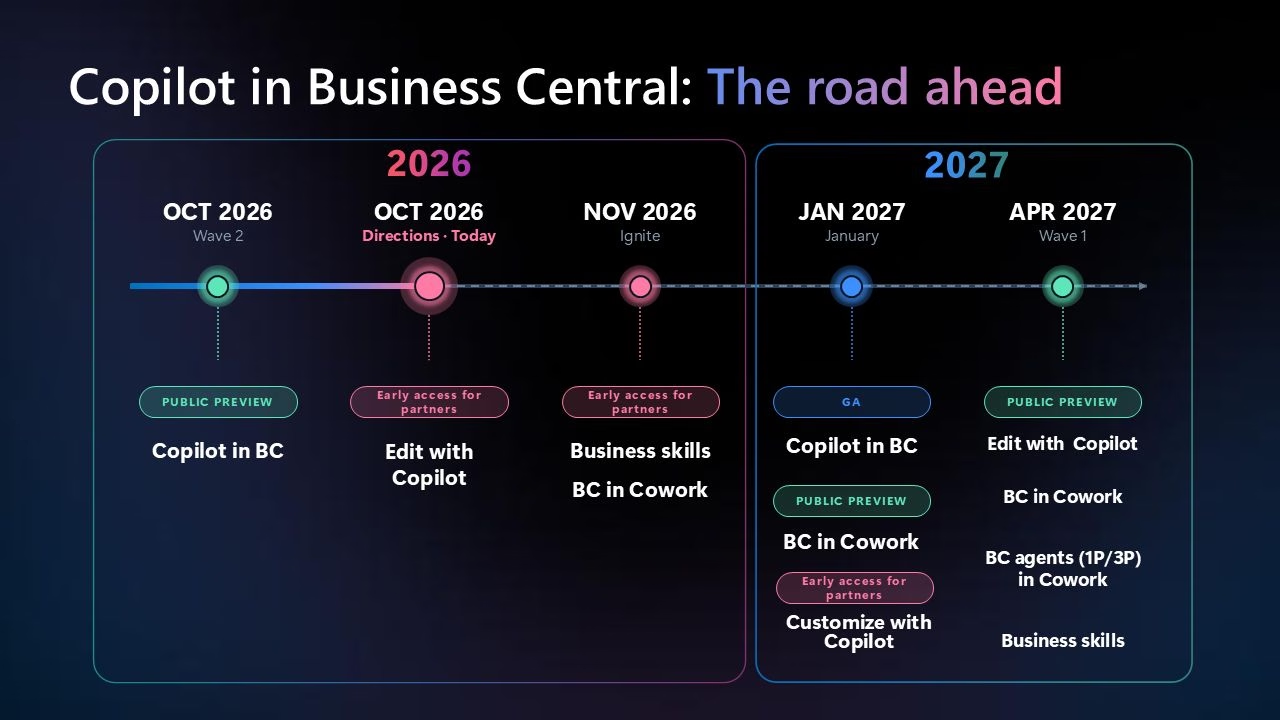
Microsoft’s Copilot roadmap for Business Central, presented across both days of the event, places general availability of Copilot in Business Central in January 2027. The new Microsoft Copilot experience began replacing the earlier Chat with Copilot feature in public preview with Business Central version 29 in October 2026.
During the opening keynote, Business Central General Manager Aida Seifi Labrosse also demonstrated a connected Copilot experience that combines Business Central data with emails, Teams messages, files, and external web information. In the demonstration, Copilot analyzed the effect of European transport disruptions by drawing on inventory data alongside outside sources.
Business Central comes to Microsoft 365 Copilot Cowork
Microsoft also plans to bring Business Central into Microsoft 365 Copilot Cowork, the agentic capability within Microsoft 365 Copilot that carries out long-running, multistep tasks across apps and data. Copilot Cowork became generally available in June 2026, requires a Microsoft 365 Copilot license, and is billed based on usage through Copilot Credits.
With Business Central in Cowork, users will be able to delegate multistep ERP tasks from within Microsoft 365 rather than completing each step inside Business Central. Public preview is scheduled for January 2027, and Microsoft’s roadmap lists a further preview of Business Central agents in Cowork in April 2027.
Today, connecting Copilot Cowork to Business Central requires a custom integration built on the Business Central MCP server. A native experience would remove that step for users, although Microsoft has not yet announced a general availability date.
Edit with Copilot brings natural-language record changes
Edit with Copilot will allow users to complete Business Central tasks by describing them in natural language, such as creating a return order, updating a customer address, removing a duplicate contact, or posting an order. Until now, Copilot in Business Central has largely been limited to reading data and assisting with specific tasks, so the ability to make changes directly through Copilot is a meaningful expansion of its role.
Copilot works under the signed-in user’s permissions, so it cannot change anything the user could not change themselves. It pauses for approval before deleting a record, logs every record it creates, modifies, or deletes, and flags changed records with an explanation of what changed and why. Edit with Copilot entered early access preview for select Business Central partners in October 2026, with a broader public preview planned for April 2027. The capability is not yet generally available to customers and is not intended for production use. The current preview supports English only.
Business Central opens further to external AI agents
Business Central already provides an MCP (Model Context Protocol) server that allows external AI agents to access Business Central data and, when configured, create, modify, or delete records and perform supported actions. The default configuration provides read-only access, while additional operations require explicit configuration and appropriate permissions. The Business Central 2026 release wave 1 also introduced a built-in agent designer for creating custom agents. Microsoft is now extending that foundation so external AI agents can discover specialized Business Central agents and delegate tasks to them.
For organizations that use agents across several Microsoft and third-party systems, this interoperability would allow Business Central to act as a participant in cross-system workflows instead of a data source that each agent must integrate with separately.
New tools for Business Central partners
Partners will get access to much of the Business Central Copilot roadmap before customers do. Edit with Copilot entered early access for select partners in October 2026 through partner sandbox environments in the United States, United Kingdom, and Germany. Partner early access to Business Central in Cowork is planned for November 2026, and partner previews of external agent interoperability are expected between November and December 2026.
Two further announcements are aimed primarily at partners and developers, although customers will feel their effects through partner-delivered solutions. Business skills will let partners define reusable business processes, rules, and instructions that guide how Copilot and agents behave, with partner early access planned for November 2026 and a broader preview in April 2027. Customize with Copilot will generate Business Central extensions from natural-language requirements, supporting faster prototyping during customer conversations, with partner early access planned for January 2027.
Other Business Central announcements from Directions EMEA 2026
Beyond the Copilot roadmap, Microsoft used Directions EMEA 2026 to share progress on several capabilities that extend Business Central into expense management, analytics, and testing. While these announcements sit outside the core Copilot story, they affect how organizations capture data, report on it, and validate changes to their environments.
- Expense Agent updates: Microsoft also shared updates for the Business Central Expense Agent, which entered public preview in May 2026. Corporate credit card integration is planned for November 2026, followed in December 2026 by automatic identification of meeting participants from calendar invitations. Event coverage also reported that general availability of the Expense Agent is targeted for December 2026.
- Native Business Central mirroring in Microsoft Fabric: Microsoft provided an update on its native Business Central integration with Microsoft Fabric and OneLake, which delivers near-real-time mirroring of Business Central data into Fabric. The capability replicates selected Business Central companies and tables into OneLake without relying on Business Central APIs for replication, and it supports multiple companies. Public preview is planned for November 2026, and organizations will need Fabric capacity to use it.
- Page Scripting reaches general availability: Page Scripting is now generally available. The tool allows users and consultants to record journeys through Business Central pages, or generate scripts with AI, and then save, share, and replay them as user acceptance tests without writing AL code.
What Business Central customers should consider next
The Business Central Copilot announcements combine a modest licensing incentive with a roadmap that will change how users interact with the ERP over the next year. Customers already planning to add Microsoft 365 Copilot Business should review their renewal timing against the January 2027 bundle availability and confirm final pricing once Microsoft publishes its December price list.
Organizations preparing for Edit with Copilot and Business Central in Cowork should also review Business Central permission sets and Copilot Credit budgets, since both capabilities rely on existing user permissions and usage-based billing. Working with an experienced Dynamics 365 Business Central partner can help organizations evaluate the bundles, plan for preview capabilities, and set governance before agents take on more work.
Stay connected with Dynamics101 for timely coverage, independent analysis, and practical insight into the latest developments across Microsoft Dynamics 365 and the Power Platform.

